I'm still learning the technologies available on the market, so I'm not sure wich of them I will use. Now I'm learning about storage solutions like SANs, mulipath, network and clusterd file system, in details I'm deciding if and how I can setup a SAN with iSCSI and wich file system build upon it, if GFS2 (global file system from Sun) or NFS.
Consider that by now I'm still a little confused between the various solutions.
The simpler solution would be setting up only one server with its RAID hard drives for drive redundancy an NFS coupled with DRBD on the secondary server in an Active/Passive architecture synched with the primary server. But as I said I want load balacing, so I need an Active/Active, but I don't know if is it possible to achieve this with DRBD and if yes in wich way.
I like to get involved in more advanced situations so I would like to learn how to use SAN. In this case the solution would be to build a SAN wich expose its storage with iSCSI and then build on top of the SAN or NFS again or a Global File System v2 in every node of the cluster. But my problem is that I'm not sure how to build a SAN (but I feel I need only some practice) and how GFS2 is structured or, in other words, how to distribute it over the nodes of the cluster and how they will use it. Google is waiting for me.
HHALC - Home High Availability Linux Cluster
mercoledì 23 novembre 2011
giovedì 17 novembre 2011
The Goal of the Project
Except for personal satisfaction and learning, the aim of the project is to build some services.
I plan to put on a
But for them I placed some conditions, and the real fun here begins :) Server consolidation, high availability, load balancing and, possibly, centralized managment. Of course I should build everything in the small environment I have available; I hope it will be enough.
Soon I will write something about the architecture, the ideas and the problems I'm concerned!
I plan to put on a
- LAMP platform or in other word a web server (Apache), a scripting language for active pages (PHP), a database (MySQL, but I also like so much PostgreSQL, but it will become LAPP) everything over a Linux OS;
- FTP server for access data everywhere;
- development repository, either Subversion or Git, I'll see.
But for them I placed some conditions, and the real fun here begins :) Server consolidation, high availability, load balancing and, possibly, centralized managment. Of course I should build everything in the small environment I have available; I hope it will be enough.
Soon I will write something about the architecture, the ideas and the problems I'm concerned!
martedì 15 novembre 2011
The Hardware - Possessions and planning
Of the three server I have I'm going to use only two of them mainly because I don't have enough RAM nor hard drives and in this way I will split some resources of the third serve between the other two (where I can).
ProLiant is a brand of server computers that was originally developed and marketed by Compaq and then by HP. The line ML is designed for mall to medium-sized businesses and to bring expandibilty and long term efficency.
My servers are model HP ProLiant ML330 G3 and HP ProLiant ML150 G2. For connectivity I've a simple 10/100 Ethernet Switch and two router/access point wireless D-Link WRT54G modded with DD-WRT firmware.
I thing somwhere in my home I've got also one or two UPS, but I have to check.
The most difficult thing now is to plan the architecture using only the hardware I have, but this hardware is really annoying so I'm not sure about what I can use! So everytime I work building the computer I have to modify what I can do with them.
The two servers (technical description)
The most powerful server is the ML150 (year 2006) and it will be user as primary server:
The second server is the ML330 (year 2003):
And then I havn't got the 2nd network card for the second computer, because it requires only a 64bit/3.3V PCI card.... I have to buy it, shit!
Connectivity (technical description)
The switch is... a simple switch! By now I don't have plans for it but it is here....
The two Access Point are really useful because I can put the servers wherever I want in the house and the modded firmware has a very powerful and configurable console for routing and network management and analys.
DD-WRT is a Linux based alternative OpenSource firmware suitable for a great variety of WLAN routers and embedded systems. The main emphasis lies on providing the easiest possible handling while at the same time supporting a great number of functionalities. Among the most useful things there is Access Restrictions, DHCP Server and Forwarder, DNS Forwarder, Hotspot Portal, OpenVPN Client & Server, Port Triggering, Port Forwarding, QoS Bandwidth Management, QoS L7 Packet Classifier, Routing, Syslog, SNMP, SSH Client and Server, Startup, Firewall, and Shutdown scripts, VLAN, WoL, WDS Connection Watchdog, WDS Repeater Mode, Wireless MAC filter.
ProLiant is a brand of server computers that was originally developed and marketed by Compaq and then by HP. The line ML is designed for mall to medium-sized businesses and to bring expandibilty and long term efficency.
My servers are model HP ProLiant ML330 G3 and HP ProLiant ML150 G2. For connectivity I've a simple 10/100 Ethernet Switch and two router/access point wireless D-Link WRT54G modded with DD-WRT firmware.
I thing somwhere in my home I've got also one or two UPS, but I have to check.
The most difficult thing now is to plan the architecture using only the hardware I have, but this hardware is really annoying so I'm not sure about what I can use! So everytime I work building the computer I have to modify what I can do with them.
The two servers (technical description)
The most powerful server is the ML150 (year 2006) and it will be user as primary server:
- Intel® Xeon 3.0 GHz/800 with 1MB level 2, support for Hyper-Threading and EM64T
- Intel® E7320 chipset
- 1 GB of PC2700 ECC capable DDR SDRAM standard
- 1 PCI-Express Gigabit NIC (embedded) + 1 PCI FastEthernet PCI NIC 10/100 Mb
- Support for up to 6 SATA hard drives with 6 Port SATA RAID Controller
- Integrated Single Channel Wide Ultra3 SCSI Adapter in a PCI slot
- IDE (ATAPI) DVD-ROM drive
- Six expansion slots: four 64-bit/66-MHz PCI-X, one x4 PCI-Express, and one 32-bit/33MHz PCI
The second server is the ML330 (year 2003):
- Intel Xeon Processor 3.06 GHz/533 with 512KB level 2, support for Hyper-Threading
- ServerWorks Grand Champion SL Chipset with 533-MHz Front Side Bus
- 896 MB of PC3200 ECC capable DDR SDRAM standard
- NC7760 PCI Gigabit Server Adapter
- Integrated Dual Channel Ultra ATA 100 IDE Adapter with Integrated ATA RAID
- One 38GB and one 39GB Ultra ATA 100 Hard Drives
- IDE (ATAPI) DVD-ROM drive
- Four expansion slots: four 64-bit/66-MHz PCI-X 3.3Volts
And then I havn't got the 2nd network card for the second computer, because it requires only a 64bit/3.3V PCI card.... I have to buy it, shit!
Connectivity (technical description)
The switch is... a simple switch! By now I don't have plans for it but it is here....
The two Access Point are really useful because I can put the servers wherever I want in the house and the modded firmware has a very powerful and configurable console for routing and network management and analys.
DD-WRT is a Linux based alternative OpenSource firmware suitable for a great variety of WLAN routers and embedded systems. The main emphasis lies on providing the easiest possible handling while at the same time supporting a great number of functionalities. Among the most useful things there is Access Restrictions, DHCP Server and Forwarder, DNS Forwarder, Hotspot Portal, OpenVPN Client & Server, Port Triggering, Port Forwarding, QoS Bandwidth Management, QoS L7 Packet Classifier, Routing, Syslog, SNMP, SSH Client and Server, Startup, Firewall, and Shutdown scripts, VLAN, WoL, WDS Connection Watchdog, WDS Repeater Mode, Wireless MAC filter.
Why this blog?
The idea for this blog came from a friend and I think it's a really good idea.
In this way I can write a detailed history of this project, I can write everything I'll do and see the path I did. And it should be nice :)
Second I want to be useful for everybody who wants to learn about this subject.
I want to write some little how-to about system management, about network configuration, planning and designing the cluster, describe the technologies I used and the problem I will face. I would like to share my knowledge and be useful for somebody, and I also hope to find somebody more instructed than me from wich I can learn something.
I think it would be nice.
In this way I can write a detailed history of this project, I can write everything I'll do and see the path I did. And it should be nice :)
Second I want to be useful for everybody who wants to learn about this subject.
I want to write some little how-to about system management, about network configuration, planning and designing the cluster, describe the technologies I used and the problem I will face. I would like to share my knowledge and be useful for somebody, and I also hope to find somebody more instructed than me from wich I can learn something.
I think it would be nice.
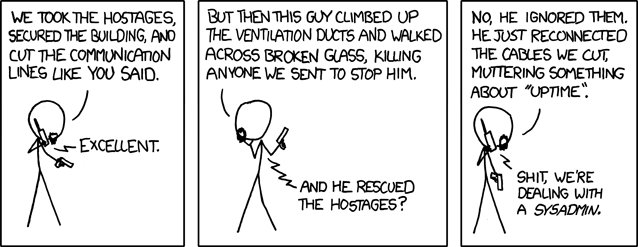
| http://xkcd.com/705/ |
domenica 13 novembre 2011
The adventure can start!
Tonight, just before a university exam about system adminstration, the adventure of building my personal cluster starts! Why tonight? Is it coincidence? No, I suppose.
First because I'm bored of studying and I need to focus on something else.
Second the idea was born because of that exam, where I found a lot of useful, wonderful, basic information about hight availability and clustering. I was always wondered about this world but I never knew where to start, where lies the differences between my home server and a professional server. I always supposed the difference was in the dedicated hardware and its correlated proprietary software, but I was wrong: hardware helps but the main difference is concept! Then, in the middle of the preparation of the exam I came in possession of three HP ProLiant server. That was enough for my mind to start wondering what will I can do!
By now I'm currently in 2 distinct phases (except preparing the exam):
First because I'm bored of studying and I need to focus on something else.
Second the idea was born because of that exam, where I found a lot of useful, wonderful, basic information about hight availability and clustering. I was always wondered about this world but I never knew where to start, where lies the differences between my home server and a professional server. I always supposed the difference was in the dedicated hardware and its correlated proprietary software, but I was wrong: hardware helps but the main difference is concept! Then, in the middle of the preparation of the exam I came in possession of three HP ProLiant server. That was enough for my mind to start wondering what will I can do!
By now I'm currently in 2 distinct phases (except preparing the exam):
- I'm physically building up the server and all the hardware infrastructure
- I'm studying all the concepts, the protocols, the applications and the topologies available and then I'll design my cluster
Iscriviti a:
Post (Atom)